
Inequality begins at birth
- From Gerrit ter Horst
- Reading duration 5 min

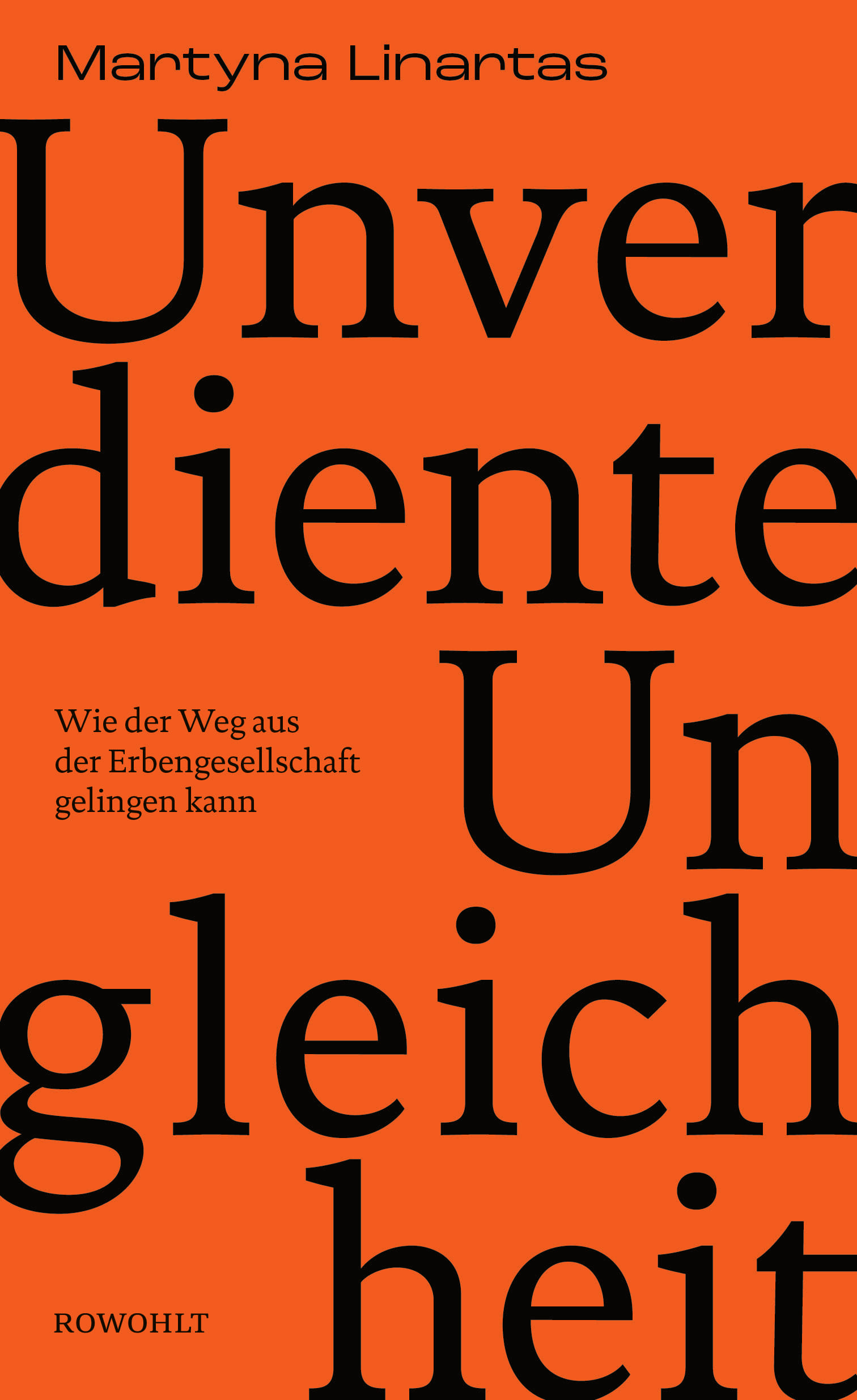
In Germany, inequality is not earned, it is inherited. While the country regularly ranks in the international midfield in income inequality statistics, it is characterized by steadily growing wealth inequality. Current figures from the Bundesbank show that 10% of all households own 60% of net wealth in Germany. A large proportion of this wealth already exists in the form of company shares, real estate and other investments and is increasing from generation to generation. In “Unverdiente Ungleichheit”, political scientist Martyna Linartas discusses ways out of the social imbalance and analyzes how inequality and the fight against it have been discussed and argued at different times.
The question of whether a society fights inequality is initially decided by whether it identifies it as a problem. Neoliberal positions on this have always been that inequality is a natural state of societies, that motivation and innovative thinking are unequally distributed and that inequality is even an incentive for those who do not yet have any wealth. The other side objects: Not only does wealth inequality have nothing to do with achievement - otherwise wealth wouldn't always stay where it is anyway - but it also creates social problems: “All the problems, security, crime and the sense of unhappiness in the population are directly related to inequality. If economic inequality increases, our health and well-being also deteriorate,” says Linartas. There are also other aspects, such as the fact that particularly rich people also cause particularly high CO₂ emissions.
“Unverdiente Ungleichheit” leaves no doubt that Linartas has sympathy for the second position. However, the author does not stop at criticising what she sees as an unfair state of affairs, but goes into historical analysis: different times have reacted differently to the challenges of inequality. In order to describe this public discourse space, Linartas creates her own paradigm-narrative model based on a theater construction:
According to Linartas, we must think of the dominant ideology, i.e. capitalism, as the theater building. Plays are performed in it - what she calls paradigms. They used to be called Keynesianism, for example, and the last play that was performed was called Neoliberalism. What the new play/paradigm will be called is the question that also occupies the Forum New Economy. Within the plays there are actors - discourse actors - and narratives, i.e. the stories of the play. A classic narrative in the paradigm of neoliberalism would be: “Every man forges his own destiny.” It is these narratives that the author is particularly interested in and which she attempts to identify for a hundred years of tax and social policy in Germany.
Linartas' narrative archaeology begins with Erzberger's financial reform of 1919/20: after the end of the First World War, a new state had to be established with the Weimar Republic and at the same time the ailing finances, which had been heavily burdened by the Treaty of Versailles, had to be restructured. The reform is regarded as the founding act of modern tax law in Germany and provided for the introduction of a progressive income tax system, as well as the uniform levying of inheritance tax and sales tax and the extraordinary Reichsnotopfer levy. As the author shows on the basis of parliamentary debates and other sources from the time, the narratives surrounding the financial reform were aimed at aspects of “justice, democracy and inequality”. The taxes introduced were not only a means of financing the state, but were also intended to create justice and enable democratic coexistence. A consensus that was reached, but which began to crack just a few years later: After Erzberger's death, a further reform was implemented in 1922, which lowered inheritance tax and introduced further exemptions. Narratives against heavy taxation of inheritances - such as the protection of the family and the promotion of the economy - had prevailed.
In this process, the author uncovers layer by layer how the debate about equality and tax justice developed in Germany, how the ordoliberals prevailed after the Second World War and how the neoliberal paradigm finally became dominant at the end of the century. Gradually, the narrative of taxes as a means of social cohesion turned into an economic obstacle that was also unfair to the taxed.
What are possible path forward? Linartas argues for a more consistent collection of inheritance tax, which could then be used to fund ideas such as seed capital for young people. However, there are still many contradictory narratives in circulation and the debate is highly emotional. Some see Germany as a business location at risk, others fear the end of family businesses, while still others are worried that grandma's house will be swallowed up by inheritance tax. In order to achieve a different form of tax policy, it will not only be necessary to make clever political proposals, but also to find the right narratives.
Martyna Linartas: Unverdiente Ungleichheit. Wie der Weg aus der Erbengesellschaft gelingen kann. Rowohlt Verlag. Hamburg 2025. 320 pages.