
The decommodified society
- From Gerrit ter Horst
- Reading duration 4 min

When the Cold War era ended in 1990/91, what Reagan-Thatcherism and its pioneers had propagated was finally to be fulfilled: The free flow of goods and transactions was supposed to bring not only prosperity but also democracy to the whole world. However, the opening up of the world and markets soon led to a major redistribution of wealth in Western industrialized countries: corporate profits rose and industrial jobs were relocated to countries with more favourable production conditions. One influental thinker who warned early on about the effects of market-liberal globalization was the philosopher Michael J. Sandel. In his book “Democracy's Discontent”, published in 1996, he described a process (in relation to American society) in which the increasing adaption of market logic was eroding the foundations of society.
Around twenty years later, a French economist and economic historian stepped onto the big stage: Thomas Piketty. With his worldwide success “Capital in the 21st Century”, he struck a chord with a time that had been sensitized to economic issues by the global financial crisis and the subsequent euro crisis. As little new as his thesis was, namely to describe capitalism as a system that inevitably promotes the concentration of wealth, a public seemed ready to engage with this thesis. Piketty's book and its success signaled one of the many cracks in the prevailing paradigm.
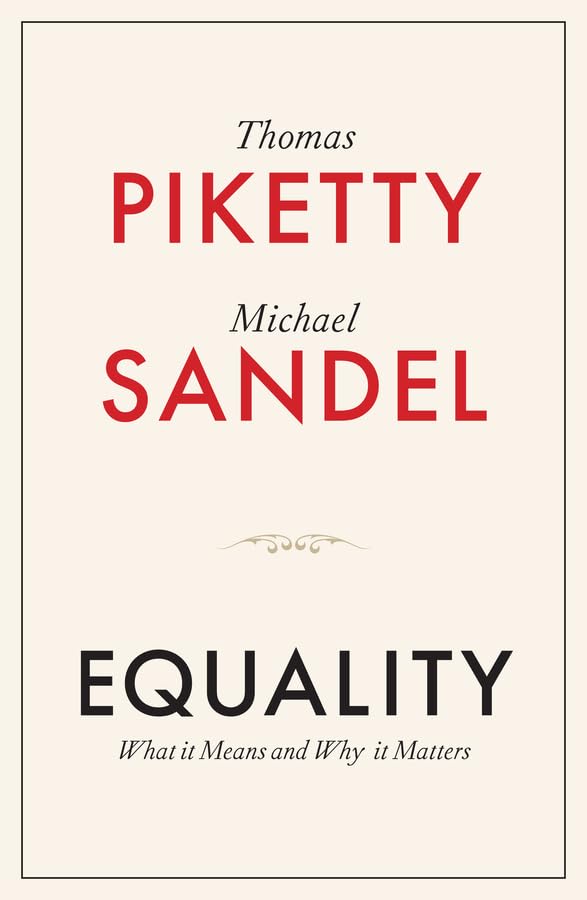
Now, another decade later, the two have come together and spoken. The result is the book “Equality: What It Means and Why It Matters”. It is a conversation in book form in which they explore the nature of inequality. They begin by identifying three areas of conflict that make inequality a problem in the first place: Access to basic goods, access to political participation and the perception of one's own position, which they describe as dignity.
Inequality is not just the difference in money to spend, but those who accumulate wealth have better access to healthcare and education, can influence political processes and possess social and cultural capital. After the Second World War, political movements reacted to this, with the two authors referring primarily to the British Labor Party and Swedish social democracy. In order to level the social playing field, they have primarily worked with two instruments that are central to Piketty and Sandel: Redistribution and decommodification.
While redistribution is primarily based on taxes and thus distributes money from the top to the bottom via progressive taxes and wealth levies, decommodification describes a process in which entire areas of society (such as education) are removed from the logic of the profit motive: A school in a tax-funded education system does not have to be profitable, but must offer good education. One of the core theses of the book is that there must be areas to which everyone in society, regardless of social status, must have access. Society is only truly realized when this is achieved. However, decommodification is not just a question of justice; there are cases in which market logic can even lead to less efficiency: The largely fully capitalized healthcare system in the US is one of the most expensive.
This kind of decommodification is more pronounced in social democratic countries like those in Scandinavia than in the US. However, neither Sandel nor Piketty have given up hope that the US can move towards greater equality: They are very openly sympathetic to figures like Bernie Sanders, who want to rebalance society by taxing wealth more heavily. And they discuss other concepts: Lotteries for university places as well as an electoral system that would force parties to take demographic and social factors into account when putting up their candidates.
Their search for answers is another hint for the era of globalized market liberalism coming to an end. With Trump, Musk and the European right, another political force is setting out to fill this vacuum. It is therefore even more important to listen carefully to Thomas Piketty and Michael Sandel in their discussion. Because it points out that inequality in its extreme form is not a law of nature, but the result of interests that have prevailed.
Thomas Piketty/Michael J. Sandel: Equality. What it means and why it matters. Polity. 2025. 123 pages.